
Sometimes the Ancient Ways Are the Best: Helping Advanced Students Fix 'Simple’ Math Mistakes
Apr 12, 2026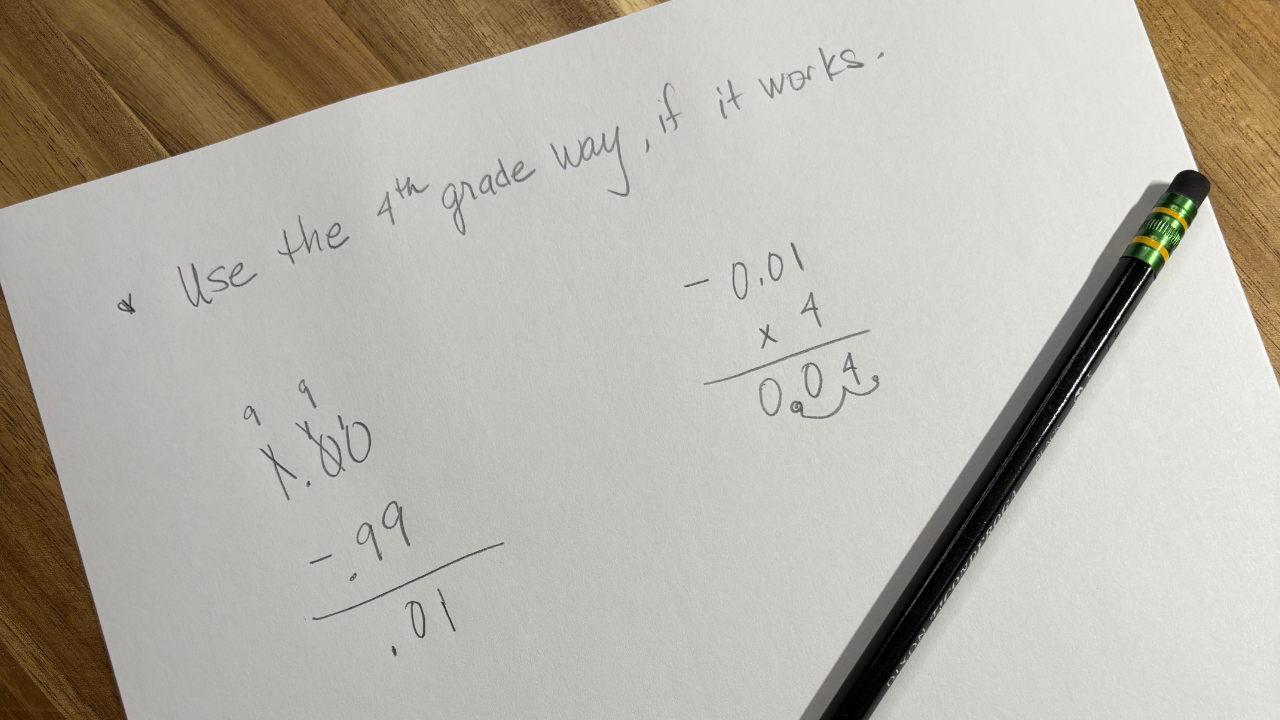
One of my students (I’ll call him Andrew) is a junior in an intensive intro to Calculus course.
He’s the type of student most parents hope for: conscientious, prepared, cares a lot about performing at his potential. In fact, he’s usually harder on himself than anyone else is. When he makes a mistake, he gets frustrated and disappointed, not because his parents are pressuring him, but because he holds himself to a high standard.
Recently, we hit a strange pattern.
We were working on a calculus idea that involved writing equations of basic lines. The kind of thing a middle‑schooler would recognize immediately. The twist: lots of small decimal numbers and no calculator.
On several problems in a row, Andrew made simple calculation mistakes:
- Adding an extra zero
- Putting the decimal point in the wrong place
- Getting .99 – 1 or 4 × (–0.01) wrong
He wasn’t lost on the calculus.
He was “doing the math in his head” and letting his brain tell him whatever answer felt right, instead of actually doing any math on paper.
So now he was stuck in a painful gap:
“I know I learned this in elementary school. So why am I getting it wrong?”
Here’s what we talked about.
I told him, “Sometimes the ancient ways are the best.”
There is a perfectly good way to subtract or multiply decimals. You just aren’t using it.
Ask any 4th grader:
- Line up the numbers with the decimal points stacked
- Write the bigger number on top
- Work right to left
- Borrow as needed
But you only get the benefit if you actually write it out and run the process, not if you hope your brain magically supplies the right answer.
As we get older, we start to feel like we’re “too advanced” for those ancient processes. They feel childish or beneath us.
My view: I don’t care if it’s childish. I care if it’s correct.
Jot the problem on your paper. Bring down the decimal. Count on your fingers. Borrow from the tens place. Whatever you learned that you know works.
Those deep, early‑grade processes do more than get the right answer. They ground the new work. Connecting 7th‑grade slope skills to “fancy” calculus makes the new material stickier and shows the student they’ve actually mastered the idea.
For Andrew, the key wasn’t just the technique. It was permission.
He needed to hear that writing it out “like a 4th grader” wasn’t a failure; it was a strength. Once he had that permission, he relaxed, started using the process he actually trusted, and the decimal mistakes disappeared.
If you remember only one thing from this story, let it be this:
Give your student permission to “use the ancient ways.”
Remind them of what they already know. Encourage them to bring those methods forward into harder classes. And when you see them use those tools and get it right, pause and celebrate it.
If you’re a parent of a high‑achieving student who’s struggling in math or science, and this sounds familiar, you can learn more about how I work with families here: www.kevinadoty.com/workwithkevin
Is your student test prep ready?
Take my quiz and get a custom report that will help you know where your student needs to focus to get the most value from their SAT or ACT test preparation.
Sign up for Kevin's Newsletter!
Join my mailing list get my regular newsletter delivered straight to your inbox with tips and tactics to help your student succeed in test prep and academics.
We hate SPAM. We will never sell your information, for any reason.
