
Online ACT Tutoring for High-Achieving Students
One section at a time, then the whole test: a systems-based approach for students whose ACT score doesn't match their transcript.
Your student earns strong grades in hard classes. Their ACT score says something different. Usually the gap isn't about what they know. It comes from how they work under the ACT's pace and those execution mistakes can be fixed.
I offer online ACT tutoring, 1:1 on Zoom, for families across the country.
Why the ACT trips up strong students
The ACT moves quickly, and it tests a wide range of material. A strong student loses points in three predictable places:
- Pace. Students who are careful in class run out of time, or they rush and make errors they would never make on homework.
- Small content gaps. One grammar rule nobody taught them, or one math topic from two years ago, shows up as a cluster of missed questions.
- Execution mistakes. Thinking under pressure reveals habits and actions that lead to mistakes. Uncovering these patterns and fixing them boosts test accuracy.
All three show up in a student's missed questions and all three respond to a system.
What the ACT looks like now
The ACT changed in 2025. English, math and reading are required, and those three make up the composite score. Science is now optional on national test dates. Students who take it get a separate science score and a STEM score. The test is shorter than it used to be and can be taken online or on paper.
Most college counselors I work with recommend taking science anyway, so a student isn't caught without a score a school requires or requests. We confirm against your student's college list early, so the practice plan matches the test they will actually sit.
How I work: section by section, then the full test
First, each section on its own. In the early sessions, each session focuses on one section: English, math, reading and, if your student is taking it, science. Your student learns how that section's questions are built, gets a working strategy, and practices it right away.
Then sections in pairs. As the strategies take hold, we start combining sections, for example English and reading in one session, then math and science in the next. The pairing depends on where your student needs the most work.
Then full tests. Before test day, your student usually takes complete timed tests, so we can see whether their strategies and pacing hold up for the full length of the exam. Advanced students may take a new full test every session. The sequence depends on your student and their program.
Through every stage, your student keeps "my mistake / my fix" reflections. For every missed question, they write down exactly what went wrong and the rule that will prevent it next time. The rules live in a shared tracker you can see. Each section also gets its own short action list: the few things your student does every time they open that section.
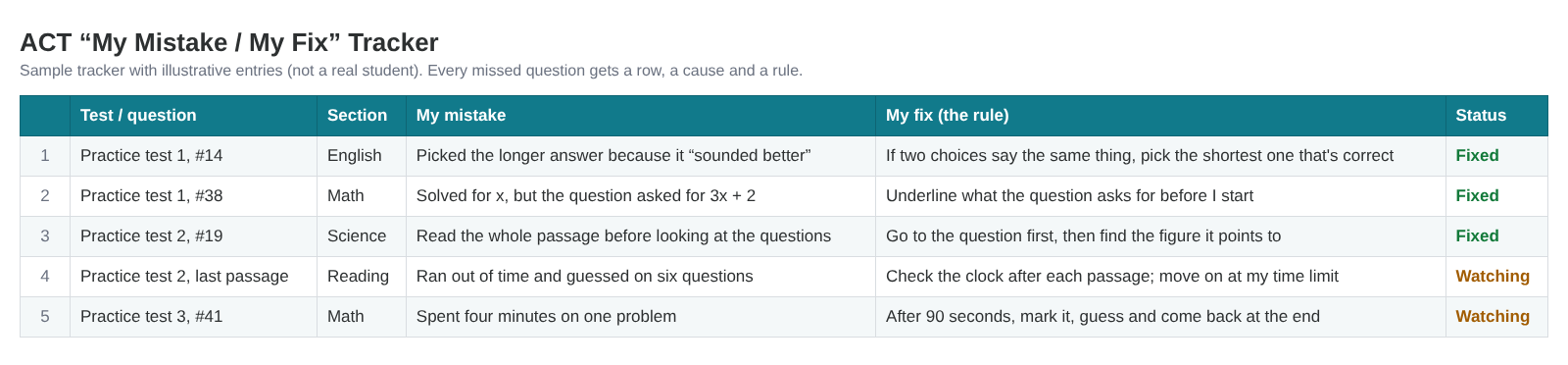
A sample tracker (illustrative entries, not a real student). Each missed question becomes a specific rule, and the rules show what to fix next.
Your student also gets:
- Full-length timed practice tests, with every missed question reviewed
- A test-week and test-day routine
- A debrief after every official test, with a plan for the next one (how that works: Using a Post Test Reflection)
Who you'll work with
I'm Kevin Doty. I work with your student myself, every session. I don't hand families off to a team of tutors.
I've tutored for 18 years with more than 9,000 hours of 1:1 sessions since 2008, working with and supporting more than 600 families. I studied aerospace engineering at Purdue, earned an MSEd from Mercy College and an MDiv from Princeton Theological Seminary, and hold a New York teaching license in physics and general science. That STEM background matters on the ACT's math section where math content knowledge is forefront and on the ACT's science section, which is mostly data interpretation, not memorized content.
What I commit to
- You'll know where things stand. Your student's work lives in a shared tracker, and you'll get regular written updates.
- An honest read on the first call. The Parent Fit Call is free. If I don't think I'm the right fit, I'll tell you plainly.
- Room to stay involved. I keep my roster small on purpose.
How working together works
- Book a free 20-minute Parent Fit Call. After you choose a time, you'll answer a few questions: grade, recent ACT or practice scores, goals, test dates and how ready your student is to do weekly work.
- Talk it through. We cover where your student stands, whether the ACT or SAT is the better fit, and whether to include science.
- Get a plan built around a test date. If we go ahead, I lay out the session sequence, the practice tests and how I'll keep you updated.
- Run the plan and adjust. We work, look at real scores, and adjust. You stay informed without having to manage it.
Who this is for, and who it isn't
This is for strong students whose ACT scores lag their grades, who will do focused work between sessions, and whose families want a system rather than another stack of practice tests.
This is not for:
- Emergency cramming a week before the test
- Students who won't do any work between sessions
- Families shopping for the lowest hourly rate
Questions parents ask
Should my student take the ACT or the SAT?
Colleges accept both equally. The right test is the one your student performs better on, and a practice test of each usually makes that clear. More here: Which test is best? If the SAT turns out to be the better fit, I tutor that too: online SAT tutoring.
Should my student take the science section?
It's optional now, but some colleges and STEM programs may still want to see it. Most college counselors I work with recommend that students take ACT Science regardless so they are not left without a score a school requires or requests.
How long does ACT prep take?
Most families plan through at least one official test date. A typical plan is about six weeks and six hours of 1:1 sessions: one section at a time first, then paired sections, then full tests. Advanced students may move faster, and the timeline depends on your student's starting point and how consistently they do the work.
How does ACT tutoring work online?
Every session is 1:1 on Zoom. We work through ACT questions live on a shared screen. Students taking the online ACT practice in that format, and students taking the paper test practice on paper.
What should my student focus on the week of the test?
I wrote a short guide: What to focus on for the ACT this week.
What does it cost?
This is a premium, low-volume service. We cover the investment on the call, once I understand your student's goals and timeline.
Ready to talk it through?
If your student's grades and ACT score are telling two different stories, let's find out why. The Parent Fit Call is free and takes 20 minutes.
ACT® is a registered trademark of ACT Education Corp., which is not affiliated with, and does not endorse, this page.
