
Online SAT Tutoring for High-Achieving Students Whose Scores Lag Their Grades
A systems-based approach for students whose strong academic records are not yet translating into consistent SAT performance.
Your student works hard, earns strong grades, and may perform well in demanding classes, but their SAT score does not reflect that same level of ability. That gap is frustrating. It is also diagnosable. I offer online SAT tutoring for high-achieving students, 1:1 on Zoom, for families across the country, and diagnosing that gap is where the work starts.
Why strong students get disappointing SAT scores
In my experience, content is rarely what holds a strong student back. A student earning an A in precalculus already knows most of the math the SAT tests. The points go to process: how the student reads each question, when they reach for a tool, and how they spend their time.
When I review a new student's missed questions, the same three patterns come up:
- A school approach to a different kind of test. The SAT rewards habits that classroom tests don't ask for.
- Not knowing how the questions are built. On reading questions, the answer is in the passage. Many math questions are faster to solve by plugging in values or graphing in Desmos than by working the algebra.
- Grammar rules nobody taught them. Good writers often haven't learned the specific rules the Reading and Writing section checks.
Each of these is a habit, and habits can be changed. If your student has just received a disappointing first score, I wrote about what to do next in My Student's First SAT Score Was Disappointing. Will Tutoring Help on the Retake?
How I work: find the pattern, then fix it
The work happens in two stages.
Stage one: learn how the test works. Your student learns a reading approach, a math approach, and the grammar rules the test uses. This is usually the stage where a student realizes how much of the SAT is predictable.
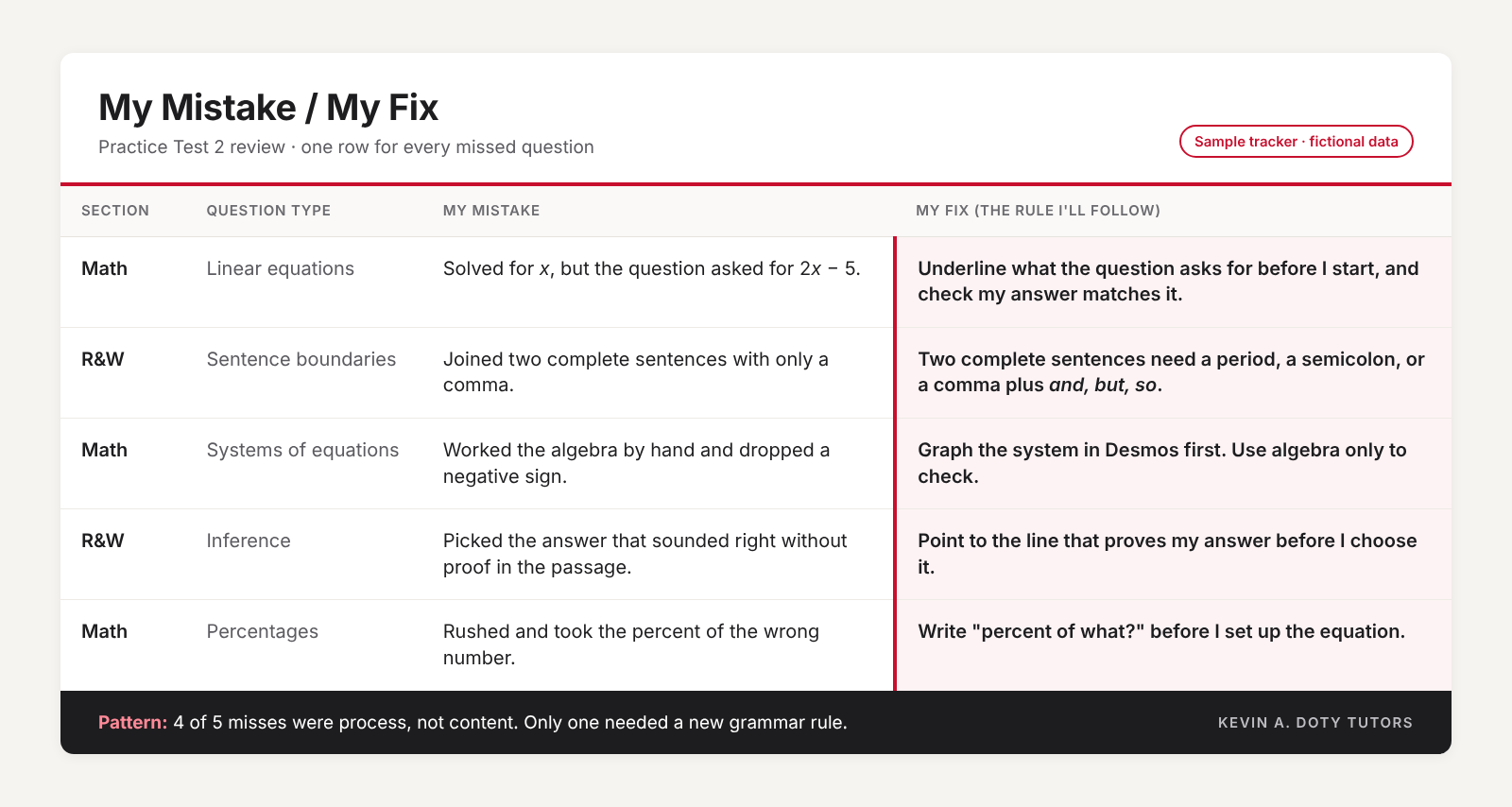
Stage two: fix the habits behind the mistakes. The mistakes that remain come from habits students don't see in themselves. A strong math student skips the calculator because they don't think they need it. A quick reader skims a question that asks for 2x − 5 and stops once they've found x.
To find those habits, every student keeps "my mistake / my fix" rules. After each practice set, they name each mistake exactly and write the rule that would have prevented it. The rules are kept in a shared tracker, so you can see them too. Across a few weeks, the rules show patterns, and the patterns are what we change.
Around that core, your student also gets:
- Full-length timed practice tests, each reviewed question by question
- Strategies for test anxiety, so they can execute when it counts
- A test-week and test-day routine
- A debrief after every official test, with a clear plan for the next one (how that works: Using a Post Test Reflection to Learn Lessons from Your Recent SAT)
Who you'll work with
I'm Kevin Doty, and I work with your student myself, every session, start to finish. I don't hand families off to a team of tutors.
I've been tutoring for 18 years: more than 9,000 hours of 1:1 sessions since 2008, with more than 600 families. I studied aerospace engineering at Purdue, earned an MSEd from Mercy College and an MDiv from Princeton Theological Seminary, and hold a New York teaching license in physics and general science. I've also taught middle school science at an independent school.
Recent students have been admitted to Oxford, Dartmouth, Stanford, the University of Michigan, Wake Forest and Loyola Chicago.
What I commit to
- You'll know where things stand. Your student's work lives in a shared tracker, and you'll get regular written updates.
- An honest read on the first call. The Parent Fit Call is free. If I don't think I'm the right fit, I'll tell you plainly.
- A debrief after every official test, so your student leaves each one with a clear next-steps plan.
- Room to stay involved. I keep my roster small on purpose.
What families say
"I came to Mr. Doty frustrated… my standardized testing results were consistently way below where they should be, considering my GPA. … after just a few sessions with Mr. Doty, I saw my results quickly improving and I gained a newfound confidence."
— Jenna Beagle, student, Indianapolis
"Kevin Doty teaches students to step back and examine their own thought processes. By doing so, they are able to identify consistent but correctable flaws. Our son is already applying what he is learning in his PSAT prep to his current high school courses."
— David Amstutz, parent, Indianapolis
"He not only helped them tremendously with the SAT but also got to know them personally… He helped them navigate some test anxiety and stress and taught them good strategies to use not only for the SAT but other tests as well."
— Marion Harris, parent
How working together works
- Book a free 20-minute Parent Fit Call. After you pick a time, you'll answer a few questions about your student: grade, recent scores, goals, key dates, and how willing they are to do weekly work.
- Talk it through. On the call we cover your student's situation, whether the SAT is the right test, and what the work will realistically take.
- Get a plan built around a test date. If we move forward, I map out the session schedule (typically weekly 1:1 sessions on Zoom), the practice tests and review rhythm, and how I'll keep you updated. For what goes into a good plan, see Creating an Effective SAT (or ACT) Study Plan with Your Student.
- Run the plan and adjust. Your student and I meet, do the work, and adjust based on real scores. You stay informed without having to manage it.
Who this is for, and who it isn't
This is for high-achieving students whose SAT scores lag their grades, who are willing to do focused work between sessions, and whose families want a system rather than more practice tests.
This is not for:
- Last-minute "our test is in 10 days, please fix it" emergencies
- Students who refuse to do any work between sessions
- Families looking for the lowest-cost hourly tutor
Questions parents ask
How long does it take?
Most families commit through at least one official test date. Finding and fixing the habits behind the mistakes typically takes four to eight weeks, depending on how much work your student puts in, how honestly they review their mistakes, and how consistently they apply the fixes.
Does SAT tutoring work online?
Every session is 1:1 on Zoom. The SAT is taken in Bluebook, the College Board's testing app, and in our sessions I review, analyze and demonstrate Bluebook questions live with your student. They practice on the same screen they'll see on test day.
Should my student take the SAT or the ACT?
Colleges accept both equally, and some students are more comfortable on the ACT. Before committing, have your student take a full ACT practice test and compare the timing, the content, and how it felt. We can sort this out on the fit call.
How many times should my student take the SAT?
For most students, three SATs is enough, and most of the college counselors I work with agree. Beyond that, extra attempts are rarely worth the time.
When is tutoring not the right step?
When the test causes a severe emotional response, a test-optional application may be the better path. When scores haven't moved after several attempts, effort is usually better spent on the rest of the application. And when a student isn't willing to do the work, no tutor can change the result.
What does it cost?
This is a premium, low-volume service. We cover the investment on the call, once I understand your student's goals and timeline.
Ready to talk it through?
If your student's grades and SAT score are telling two different stories, let's find out why. The Parent Fit Call is free and takes 20 minutes.
