
My Student's First SAT Score Was Disappointing. Will Tutoring Help on the Retake?
Oct 27, 2026
If your student just got a first SAT score back and it's far below what their grades suggest, that's very common. In my experience, a first SAT or PSAT taken with no preparation can often land somewhere between 1000 and 1100, even for students with a 3.9 or 4.0 unweighted GPA and a schedule full of AP classes.
So, will tutoring help on the retake? For most students, yes, when the preparation targets the real problem. And the real problem is usually not the one parents or students expect.
Why strong students get disappointing first scores
The SAT isn't an academic test in the way a pre-calculus final is. I tell students it's closer to a psychology test pretending to be an academic test. A student can be excellent in class and still miss questions or run out of time, because the SAT rewards different skills than school does.
When I go through a new student's missed questions, three issues show up again and again:
- No specific approach. Students take the SAT the way they take every other test, and that approach doesn't fit this one.
- Not knowing how the questions work. On most reading questions, the answer is in the passage. On many math questions, you don't need to work the algebra: you can plug in values or graph the problem in Desmos.
- Missing grammar rules. Even students who write well often don't know the specific rules the SAT tests, and that costs them significant points on the Reading and Writing section.
None of these is a gap in ability. Your student often already knows the content; the points are being lost to process.
What actually changes an SAT retake score
Stage one: learn how the test works
With a basic approach to reading, a basic approach to math and the grammar rules the test actually uses, students usually move into the 1250 to 1300 range without much difficulty. This is the stage where a student says, "Wait, that's all the test is doing?"
Stage two: find the habits behind the mistakes
Getting past 1300 takes longer, because the remaining mistakes come from habits students don't know they have. Two I see often:
- Skipping the tools. A strong math student doesn't use the calculator or Desmos, because they believe they don't need it.
- Skimming the question. A quick student is used to understanding things fast. The SAT doesn't ask trick questions, but it does change what it asks. A math question may ask for 2x − 5 instead of x, and a student who skimmed it solves for x and stops.
This is where my "my mistake / my fix" rules come in. After each practice set, the student names every mistake specifically and writes the rule that fixes it. That forces them to slow down and look honestly at their own performance. Over time, the rules show patterns in the mistakes, and the patterns are what we change. The goal is consistent accuracy: applying the same approach the same way every time.
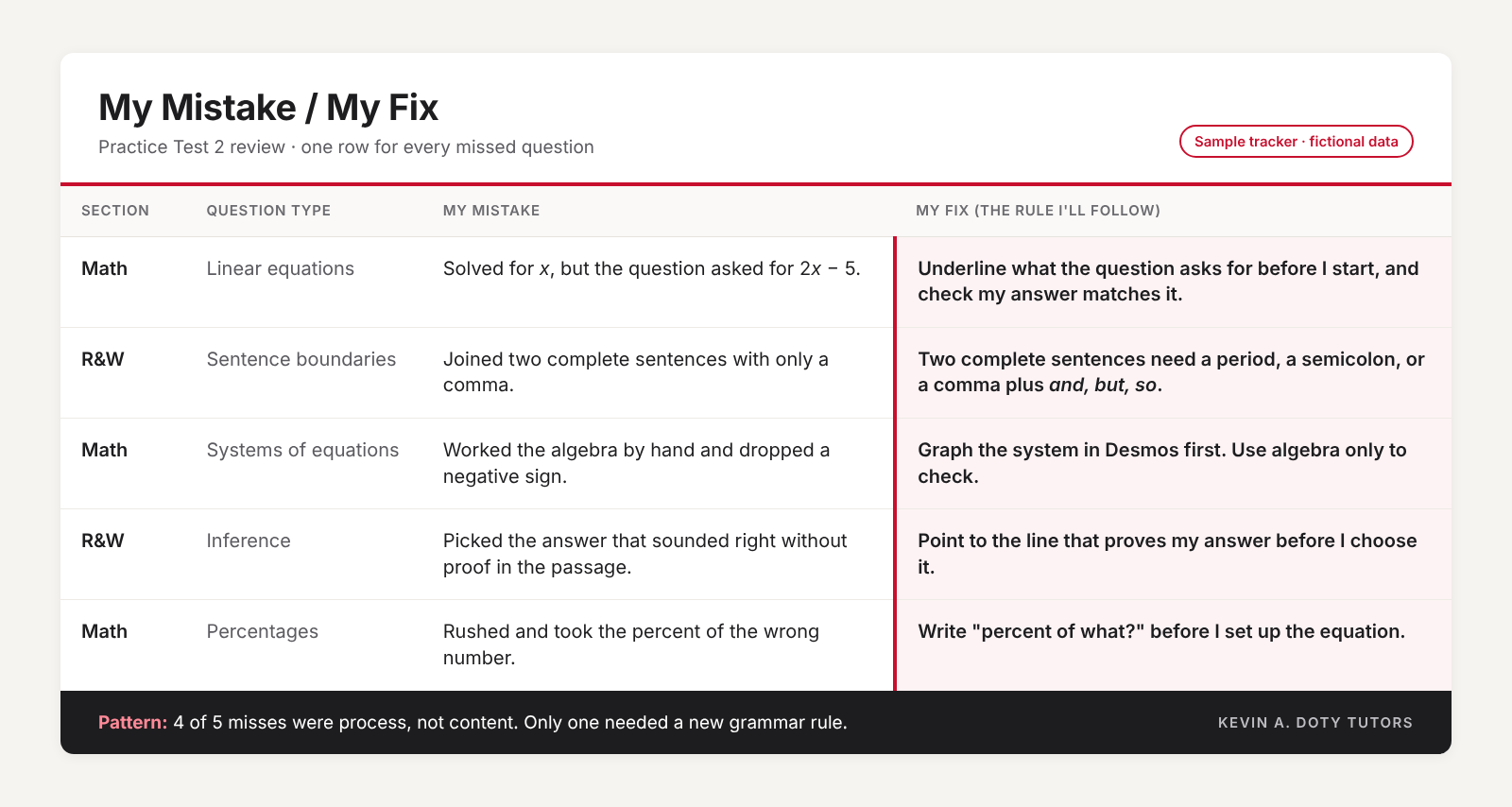
A sample "my mistake / my fix" tracker. Each missed question gets a specific rule, and the pattern across the rules shows what to change.
My athlete students tend to get this right away. Say you're learning soccer. First you learn how the game works: which way the ball goes, how to take a throw-in. That doesn't make you a good goalkeeper. A goalkeeper has a specific job, and getting good at it takes specific practice, repetition and honest review of what's going wrong. Stage one is learning the game. Stage two is learning your position.
This stage typically takes four to eight weeks. The range depends on how much work the student puts in, how well they reflect on their mistakes, and how consistently they apply the fixes.
What this looked like for one student
One student I worked with was strong and worked very hard, but his first section scores were well below what his grades suggested. He studied the test diligently. When we went through his missed questions, we found he wasn't really reading the questions. Under pressure, he got nervous and skimmed.
The fix sounds almost too simple: a plan for reading the question. Read it once, make sure you understand what it's asking, and take a moment to process it before you start. Don't rush ahead, and don't reread it over and over. Once that plan became his routine, he stopped losing points to questions he already knew how to answer.
What doesn't help after a disappointing score
Treating the score as a verdict on the student
Start with how your student feels. A 500 in math next to an A in pre-calculus can make a student wonder whether they're as capable as they thought. They are. The test measures something different, and the way a student thinks under pressure may or may not help on this test. Blame doesn't help, whether it comes from a parent or from the student. Treat the score as information about what to fix.
Taking practice test after practice test
For most students, piling up practice tests doesn't change much on its own. Some students do well with a book, an app or a course. For a few, a handful of practice tests is enough to see what happened. But a practice test you don't review gives you repetition without information.
Retaking right away
I would not rush to the next test date. Unless your student has figured out what went wrong and what they're going to change, the next score will probably look like the last one.
What to do over the next 8 to 12 weeks
- Check your student's bandwidth. Most students didn't prepare the way they meant to the first time, or the way their parents asked them to. Before anything else, make sure there's real time and energy for preparation this season.
- Pick a test date. A deadline turns good intentions into a plan.
- Name exactly what went wrong. That means no blame and no excuses. Name the specific fix: "I'm going to learn the grammar rules and practice them methodically," or "I'm going to work on these kinds of math questions until I understand what I'm doing."
- Take a practice test and review it carefully. Check every answer, and write down what went right and what went wrong.
- Consider the other test. Colleges accept the SAT and the ACT equally, and some students are more comfortable on the ACT. Take a full ACT practice test first and compare honestly: the timing, the content and how it felt. Don't switch blindly.
If your student wants a structured way to do this, I have a free 3–4 Week SAT Rescue Plan you can download.
How many retakes are enough
For most students, three SATs is enough, and most of the college counselors I work with agree. Three SATs and an ACT can make sense if a student changes direction. Beyond that, the extra attempts are rarely worth the time.
When tutoring isn't the answer
Tutoring isn't always the right next step:
- The test causes a severe emotional response. If a student is in tears over the test or shutting down, testing may not be the right path. Some big emotions are normal and manageable, but many excellent colleges are test-optional, and applying without a score may be the better choice.
- The scores aren't moving. If a student has taken the test several times with the same result, their effort is usually better spent on the rest of the application. Strong grades in demanding classes already show academic ability, even when a standardized test doesn't.
- The student isn't willing to do the work. Whether they're overcommitted or just don't want to, a student who won't put in the time won't improve. The best tutor in the world can't change that, and it isn't a good use of a family's time or money.
If the first score was disappointing
A disappointing first score is common, and it's usually a process problem rather than an ability problem. Find out what went wrong, fix it deliberately, and give the fix time to become a habit before the next test date.
Strong grades. Disappointing test scores. Let's close that gap. I'm Kevin Doty, and if you'd like a second set of eyes on your student's score report, here's how I work with families.
Is your student test prep ready?
Take my quiz and get a custom report that will help you know where your student needs to focus to get the most value from their SAT or ACT test preparation.
Sign up for Kevin's Newsletter!
Join my mailing list get my regular newsletter delivered straight to your inbox with tips and tactics to help your student succeed in test prep and academics.
We hate SPAM. We will never sell your information, for any reason.
