
My First ACT Was a 30. What Changed?
Nov 04, 2026
What changed after the first test was not simply more practice. It was a clearer process for identifying mistakes, building rules, and executing under time pressure.
A 30 on a first ACT is a strong score. Most of the students who come to me with a 30 are already excellent students. Many of them walked into the test with little extra preparation, just to see how it would go.
They aren't unhappy with a 30, but they usually have a specific number in mind: a 32 or a 33. That's not a huge jump on paper. It matters because there's often a goal attached: a top 20 or top 50 school, a specific program like direct admission to Indiana University's Kelley School of Business, or a merit scholarship with a cutoff.
They don't just want a 32. They need it to move their plans forward.
And this is where many strong students get stuck. They've already done most of what a good test taker does. They don't know what else they could do to get there.
Why a 30 is harder to move than a 20
A student moving from a 20 to a 25 usually needs content: grammar rules, math topics, reading strategies they've never been taught.
A student at a 30 has already picked up the easy points. I don't have to convince them to use process of elimination. They read well. They know their math. The last few points have to come from somewhere else.
Where the last few points usually go
When I review a 30 student's first test, the misses tend to look the same, section by section.
English
A handful of grammar rules they never learned, usually punctuation. These students write well, so they've been choosing by what sounds right. On the ACT, "sounds right" isn't good enough.
Math
The problem here is rarely new content. More often it's a geometry idea or a skill they haven't used in a while, even something like proportions. Once we look at it, the reaction is "Oh yeah, that's how I do that." It's tightening content they already know.
Reading
Two things. First, a plan for working through the questions, so they can read thoughtfully in the time they have. Second, knowing that the answer is in the passage. The ACT is not hiding it. That one surprises a lot of students.
Science
Science comes last, so after a full test in order, students are tired. The two common mistakes look a lot like Reading: no plan for skimming each passage, so they spend too long reading the setup, and not going straight to the table, chart, graph or text where the answer is. The usual reaction: "Wait, that's all I have to do?"
The pattern underneath all four
Strong students overthink the ACT. They bring all their academic firepower to a test that doesn't ask for it or need it. The ACT is not trying to trick you. It wants you to answer the question, and most questions don't need a great deal of problem solving to answer.
You can't practice your way to a different score
This is the most important point, whether a student works with me or not.
Repeating practice tests won't change the score on its own. If nothing changes in the approach, the grammar rules or the math ideas a student is relying on, the next test will look a lot like the last one. "If I do four practice tests, I'll get better" usually isn't true. The same holds on the SAT, as I wrote about in retaking after a disappointing first SAT score.
What works is thoughtful practice. That means looking at each miss, being clear about exactly what went wrong, and deciding exactly what to do differently next time.
At this level, most misses are what I call execution mistakes:
- reading the question too fast
- skipping over part of the question
- assuming you know what the question is asking
These are test habits. Students do the same things on school tests, but there they often don't cost points: the wording is easier, or the pressure is lower. On the ACT they do. So the work is to identify the habits that need to change and then actually change them. Changing habits takes time.
What "my mistake / my fix" looks like
The way we do this is a simple record I call "my mistake / my fix." After each section, the student writes down why they missed each question and what they'll do differently. It works the same way as a post-test reflection after an official test.
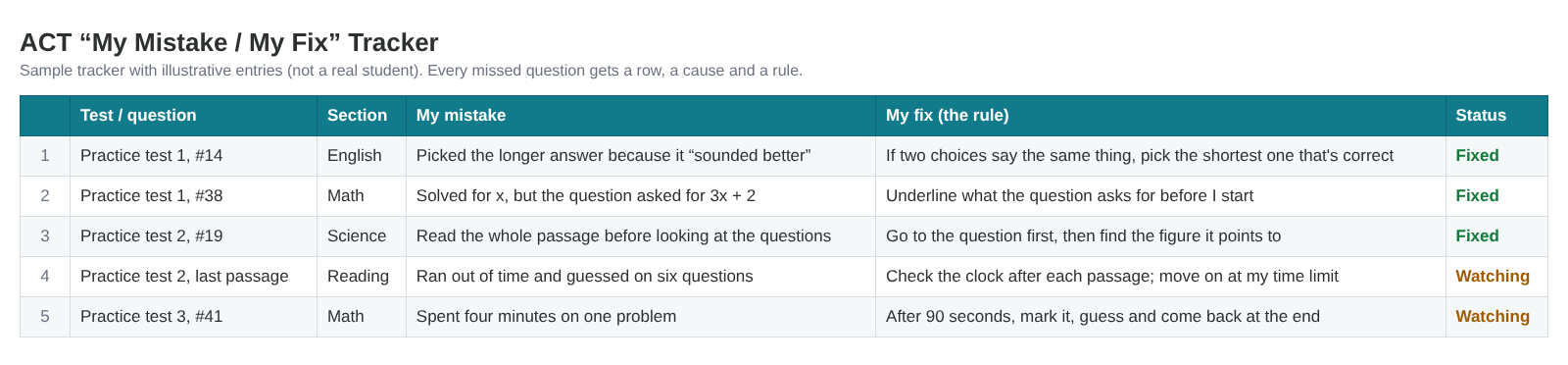
An example tracker (not a real student's). Repeated mistakes show up fast.
The writing isn't the primary point. The point is that the student sees the reason for themselves. "This is why I'm missing this question. I wrote the same thing four times. That's a habit, and I need a better one to replace it."
Two things happen almost every time we review missed questions together. First: "How did I miss that?" Once they slow down, the question looks easy. Second, there's always a pattern, even when a student only missed six or seven questions.
What changes, and when students see it
Here's how it usually goes. In the first session, unless one section is far behind the others, we start with English and go through every missed question. I give the student a process for that section. Most of the time they're already doing most of it. What they're usually not doing is coming up with their own answer before they look at the choices.
Then I ask them to redo their missed questions. The usual reaction is "That was so easy. I think I could get most of those right." Then they take a new English section, and the number of misses drops. My goal for the next round is always to cut the number missed in half.
That's the moment that matters. I'm not just telling them they can do better. They took a new section and got more right, and they can see that the things we worked on were the right things.
Some of my students have gotten even more out of this by practicing beyond what I assign: extra grammar questions, extra tests, and digging into every miss on their own. With the framework in place, that extra work pays off.
A realistic plan from 30 to 32 or 33
For most students, I plan for 6 to 8 weeks: one hour-long session a week. That gives a student time to reflect on the previous work and do a new section or test before the next session. It's the same rhythm I use in all my online ACT tutoring for high-achieving students.
That pace matters because these students are busy. Many juniors are taking three to five APs, plus precalculus, a sport, and everything else. Squeezing prep into two weeks rarely works. I've written more about balancing test prep with a heavy course load.
Between sessions, the work depends on the assignment. A single section plus reflection takes about 30 to 45 minutes. A full practice test takes longer, and so does reviewing it, though at this level even a full test might only have 10 or 12 misses.
We start with single sections, so a student can sharpen the process for one section at a time. Once the misses are coming down, we move to full practice tests. That's where we work on endurance, pacing, and taking each section as it comes, so the student walks into test day with a clear routine.
When a 30 is enough
Sometimes the right answer is to stop. If a 30 already puts a student at or above the 75th percentile of admitted students at the schools on their list, it's okay to be done.
The rest of the application matters too: grades in demanding courses, strong relationships with teachers who will write recommendations, and something distinctive the student can explain to a college. And the time has to come from somewhere. A fall or spring sport, a job, or a family situation that takes a lot of mental space all count.
A higher ACT score isn't a magic bullet. It often strengthens everything else a student brings, and sometimes it clears a minimum for a merit scholarship. But putting every hope on one score is a recipe for disappointment in admissions.
The next step
If your student's first ACT was around a 30 and there's a specific goal attached, a short conversation can tell us whether more prep is worth it and what it would take. Book a free Parent Fit Call.
Is your student test prep ready?
Take my quiz and get a custom report that will help you know where your student needs to focus to get the most value from their SAT or ACT test preparation.
Sign up for Kevin's Newsletter!
Join my mailing list get my regular newsletter delivered straight to your inbox with tips and tactics to help your student succeed in test prep and academics.
We hate SPAM. We will never sell your information, for any reason.
